Showing posts with label International. Show all posts

Saturday, December 5, 2015

Remembering Stella Young

Stella Young died one year ago today. She is still my favorite well-known disability activist, writer, and role-model, and I miss her voice and her “cracking brain” so much.

I wanted so much to re-post some amazing videos from Stella’s Memorial Service in Melbourne, Australia, but it turns out the Australian Broadcasting Corporation owns those videos, and though they are still on YouTube, they can’t be viewed here in the United States. What the hell?! That really pisses me off!

Instead, I’ll share my two favorite pieces of Stella’s writing:


Her TED Talk on “Inspiration Porn” is essential:


I would so love to hear what Stella would have to say about Kylie Jenner.

----------

Thursday, December 3, 2015

Disability Day

United Nations symbol, white lines against a dark blue backgroundToday is the annual United Nations International Day of Persons with Disabilities, which has included a whole slate of UN sponsored speakers and events, and a whole lot of social media activity calling attention to disability as an important identity and issue world-wide. As “day-days” go, it’s definitely a step or two above the scores of semiofficial days commemorating postage stamps, snack foods, and other trivia. This is really A Thing.

This year’s themes for the day are:
  • Making cities inclusive and accessible for all
  • Improving disability data and statistics
  • Including persons with invisible disabilities in society and development
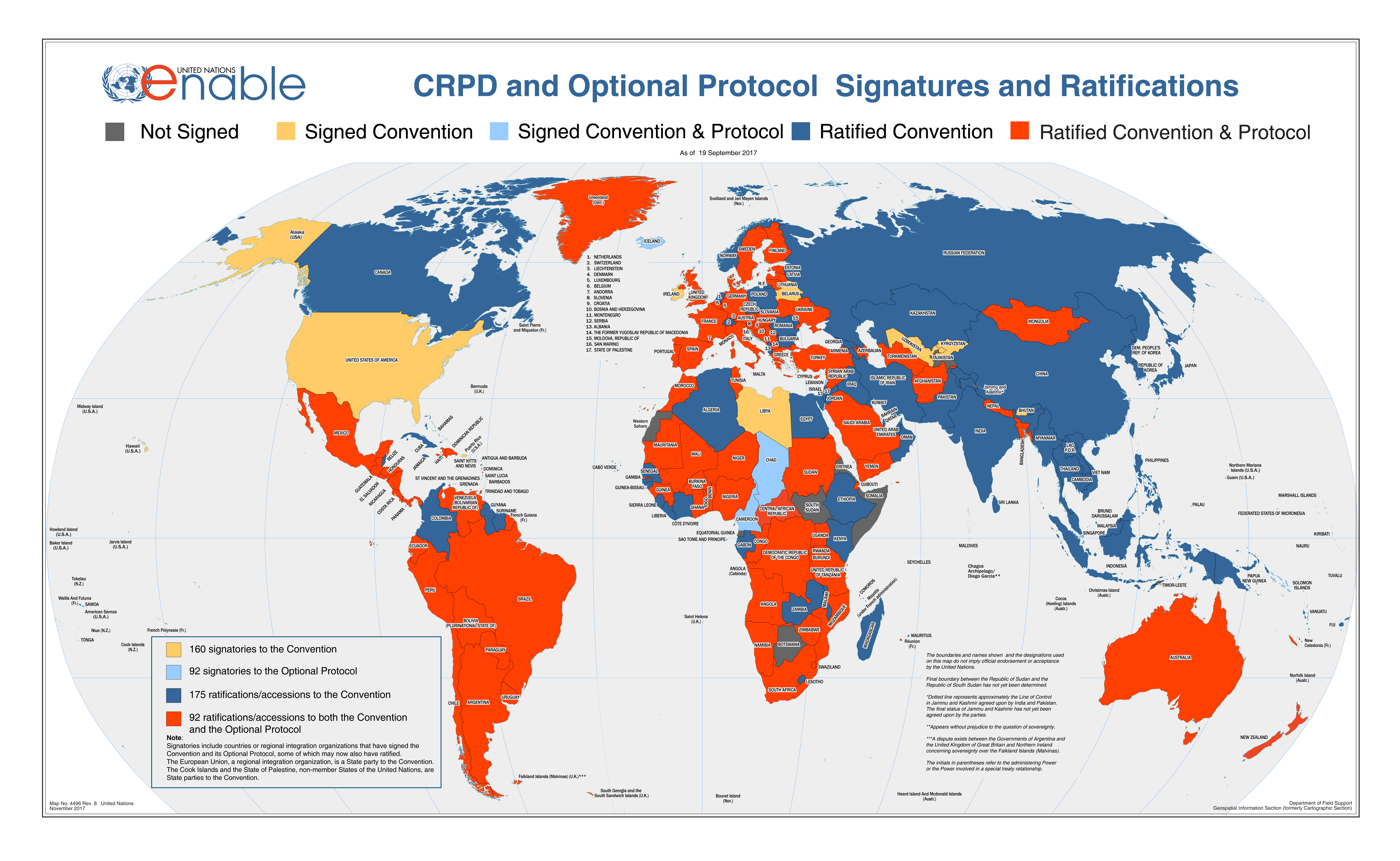
The first thing that came to my mind is the status of the UN Convention on the Rights of Persons with Disabilities. The United States signed the treaty, but the Senate hasn’t ratified it, so our participation in it isn’t actually in effect. Most other countries in the world have fully ratified this disability rights treaty. The United States is in fine company balking at fully endorsing … along with Libya, Chad, Uzbekistan, Kyrgyzstan, and North Korea. A few more Senators should probably get over their bizarre superstitions about UN officials micromanaging parents’ relations with their disabled kids, and ratify the damned treaty already. The United States is the world’s leader in disability rights … it really is. It’s about the last country on Earth that should worry about disability rights being included in international law.

Click Here for a map showing the signatory and ratification status of all participating countries.

----------

Tuesday, September 8, 2015

Access or Awareness?

Logo of BBC Ouch: Disability Talk
BBC Ouch: Disability Talk - September 3, 2015

The always excellent Ouch: Disability Talk podcast from the BBC recently spoke to three people with cerebral palsy who live in Japan, about what life is like in Japan for people with physical disabilities. All three live in Japan by choice, having moved there from the United States, the United Kingdom, and Canada. All three love living in Japan. They specifically praised Japan's accessibility and plentiful transportation. All three said they have much more freedom and mobility living in Japan than they ever did at home.

On the other hand, while they cited the fundamental hospitality and friendliness of Japanese people, especially towards “western” visitors, the expatriates all spoke of encounters with Japanese culture's explicit and unashamed ableism. Disabled foreigners are treated well, because Japanese people love guests and find westerners fascinating. Disability, however, is widely and openly viewed as ugly and embarrassing … an unsightly disruption to the smooth, calm exterior appearance of a deliberately conformist society. While ableist discrimination happens everywhere, in the US, UK, and Canada, there is at least a general agreement that disability discrimination is wrong, something to be frowned upon, hidden or disguised. In Japan, disability discrimination is considered natural and more or less logical. For instance, in Japan, it’s considered perfectly fine to deny a job to a wheelchair user, for no other reason than that a disabled person might be disruptive and upsetting to others.

I am fascinated that all three of the disabled people interviewed clearly love living in Japan, and feel that the country’s better, more accessible infrastructure more than compensates for the society’s often stunning lack of “disability awareness.” This has implications for the long simmering debate within the disability community between two apparently competing priorities: accessibility vs. awareness.

People who focus more on accessibility and other systemic justice issues say that if our infrastructure and laws are good for disabled people, then peoples' individual prejudices won't matter so much. Others argue that ramps and non-discrimination laws by themselves don't bring true equality, which depends in the end on how well people understand and accept disability.

My own perspective has always been on the accessibility side of the argument. If I had to choose, I would prefer a more accessible community that is less understanding, to community of compassionate people "aware of" disability, but full of physical and systemic barriers. The three people interviewed seem to agree, but I wonder if they will still feel the same in a few more years. What if the novelty of excellent accessibility wears off, while the persistent ignorance of neighbors and colleagues grinds away at your soul? Living in a wheelchair-user's paradise might not be as great as it seems to be at first.

----------

Tuesday, July 28, 2015

Keep Your Eyes On The UK

Photo of a 20 dollar bill being cut in half with scissors
There’s probably going to be some kind of engineered showdown over funding Social Security Disability here in the United States. Disability activists are going to be pulled in a few different directions. Should we join the effort to “reform” the program and risk validating benefit cuts and narrowing eligibility? Or, should we line up to defend the program as it is, and miss the opportunity to reduce work disincentives and make other improvements we’d actually like to see?

Before we get too far down the road, we should pay careful attention to what’s been happening with “welfare” cuts in the UK, including cuts specifically affecting disabled people:
"One thing the welfare bill accomplishes is to put people who have failed a fitness to work test on to the same payment as people who have passed it, like some tent-revivalist preacher tipping sinners out of wheelchairs and screaming “Walk!” Who would have thought that electing people who hate the welfare state to run our welfare state could go so badly? In practical terms this change means people with things such as MS and Parkinson’s will lose £30 a week. That extra £30 a week was there because, sometimes, chronically ill people’s bodies don’t work so well and they might have to get a bus or a cab or pay the babysitter to stay for an extra hour so they can get to and from the latest humiliation from the Department for Work and Pensions."
This is from an angry article in The Guardian about the Labour Party, the UK’s main left-of-center party that historically has fought for the welfare state and defended the UK’s poor and working class. It’s roughly … and I mean very roughly … equivalent to the US’s Democratic Party. Yet, apparently they are pretty much going along with the Conservative Government’s austerity policies, which include a two-faced stance on disability policy.

Publicly, they use the language of empowerment and confidence in disabled peoples’ ability to work and be self-sufficient, while policy-wise they cut benefits and make everyone who gets benefits prove to poorly-trained bureaucrats that they really do need their government support. Meanwhile, they nudge and wink and tisk-tisk about “welfare scroungers."

It sounds familiar. The same kind of thing could easily happen here, if we aren’t very careful.

By the way, £30 a week, £120 per month, is equivalent to almost almost $47 per week, $187 per month. That's more than the cost of a few lattes.

----------

Saturday, June 20, 2015

Catching Up On "Ouch"

BBC Ouch: Disability Talk logo
A couple of evenings ago, I decided to catch up on a backlog of podcast episodes of Ouch: Disability Talk, the BBC's program dedicated to disability issues and culture. I keep forgetting how good the show is.

The hosts seem to have similar beliefs about disability as the activist disability bloggers I read, but they sound like they don't have to try as hard to express those beliefs.

They are casual and breezy ... aware, but not angry.

They are plain spoken, and steer clear of insider jargon.

They don't reject so-called Political Correctness, but they seem less anxious about it than one might expect.

Ouch gives equal voice to a broad spectrum of disabled people, including some with beliefs and ways of talking about disability that I don't like, that make me uncomfortable. Everyone gets a fair chance to say their piece. Meanwhile, the hosts ask probing questions, but don't pass judgment.

Of course they are British, and I like the way they say things, one minute funny:
"I was like, shuffling around like a granny, even more than I usually do."
The next, insightful:
“I think it’s true that people do want to get diversity. But it’s almost as if people want the “easy” disabilities ... I put that in very marked quotation marks … but you know they don’t want to deal with complex disabilities where lots of changes have to be made."
Ouch's hosts and guests often state flat-out some things we often think, but struggle to express:
Interviewer Kate Monaghan: "Surely all parents just want the best for their child?"
Guest Tracey Abbott: "Ah, all parents want their child to be as safe as they can be, and happy. That doesn’t necessarily equate to them going out and getting a job."
It's worth noting that later in the same show, Ms. Abbott says some pretty ignorant, borderline hateful things about what does and doesn't constitute a "real disability," which prompted a good deal of polite but sharp discussion among the hosts and guests.

And who could resist a show on disability with episode titles like:

“You walk funny"
Losing a leg, and being mugged
Who can use accessible loos?

I will be listening to Ouch more regularly.

----------

Thursday, April 2, 2015

Making Accessible Campaign Propaganda (ahem) Materials

BBC News - March 26, 2015

I am not aware of anyone in the United States making a high-profile, publicized attempt to produce political campaign materials specifically for voters with intellectual disabilities. It sounds like a worthwhile thing to do, and a pretty interesting task.

For one thing, there are so many types and shades of intellectual disability ... which I believe is what the BBC means when they say, "learning disability".

And how, exactly, does one "translate" a party platform so that intellectually disabled people can understand it? What does "simplifying" mean? Do you take out all the metaphors and colloquial phrases? Do you use shorter words and fewer compound sentences? How does "large print" help an intellectually disabled person with (most likely) normal eyesight?

Or, is it about more than grammar and font size? Are there social studies texbooks designed to teach adults with intellectual disabilities what "liberal", "conservative", and "libertarian" mean? Do you try to alert intellectually disabled voters to opaque, misleading slogans that all sound good, even when they contradict each other?

I would really like to learn more about this.

----------

Facebook

Wednesday, March 11, 2015

Jane Hawking’s Not-Bad Idea

Photo of a stack of newspapers with Breaking News! in large headline print
The Guardian - March 11, 2015

“The Theory Of Everything”, the film about Steven Hawking that won Eddie Redmayne an Oscar this year has caught a lot of flack from the more activist parts of the disability community, including me. In brief, we’re tired of non disabled actors winning awards for playing disabled characters, especially when disabled actors can’t get work. Plus, we hate to see tired old clichés repeated, such as the scene where Hawking … while being recognized for his astounding achievements in physics … dreams of walking again. Forget being one of the most recognized and admired physicists of all time, I just wish I could walk over and pick up a pencil.

All that aside ...

I was really impressed that Jane Hawking, Steven’s first wife who is also portrayed in the film, used a gala reception at Buckingham palace, for a very traditional disability “charity”, to suggest that what disabled people in the UK really need is better support from their government. Usually, these charity “dos” are all about raising donations for a cure, and are carefully apolitical. It’s one reason why so many disability advocates shy away from traditional charities.

Jane Hawking’s proposal is pretty vague … to use funds from companies that don’t pay taxes now to fund better support services. But it is radical and refreshing for her to even mention systemic change and economic justice in a high-profile charity event.

For what it’s worth, I don’t think we have ever heard anything so specific and political from Dr. Hawking himself, who when he talks about disability tends to stick with a very personal perspective and a somewhat blandly neutral tone. I’ve always kind of liked that about him, that he neither bemoans nor romanticizes his disability. It would be helpful, though, if he had more to say about disability in general, and the status of disabled people in society.

Anyway, I just think that Jane Hawking deserves some praise for her observations, and where and when she chose to make them. More like this please.

----------

Thursday, February 26, 2015

Throwback Thursday

Illustration of the time machine from the movie Time Machine.
A year ago in Disability thinking … Thank You Gail Collins.

The New York Times Columnist pushed for ratification of the UN Convention on the Rights of Persons with Disabilities.

----------

Facebook

Tuesday, February 24, 2015

Disability In The UK, Viewed From The US

Guardian Staff, The Guardian - February 23, 2015

I’m not that interested in this article specifically. I’m citing it only because it got me thinking about how disability issues and disability culture in the United Kingdom are different than they are in the United States. They’re different, but in subtle ways I haven’t quite mapped out yet.

- It seems like ableist slurs and personal harassment get more mainstream press in the UK than they do in the US.

- It also seems sometimes like disabled people in the UK fight more for benefits than they do for civil rights. If so, it’s probably because they are forced to, and I worry that we’ll soon have to do the same here in the US.

- I have also noticed that there is a lot less discussion in the UK over terminology. It seems like either they settled all those questions years ago, or else they just do care about it as much. Everyone seems to use “disabled” and “disability” and leave it at that.

I guess this is a comment thread. I’d like to know, from both British people and American observers, what’s different about disability in the UK?

Saturday, December 20, 2014

Stella Young Memorial

Melissa Davey, The Guardian - December 18, 2014

A memorial event for Stella Young was held on Thursday, December 18, in the Town Hall of Melbourne, Australia.

I don’t have anything to add really. Just watch the videos.

Nelly Thomas


Graeme Innes


Stella Barton

Tuesday, October 28, 2014

Blogging Note ...

I am working on some kind of blog post about that recent case in the United Kingdom where a judge ruled that a mother had the right to order a stop to care and feeding for her disabled daughter in a hospital, leading to the girl's death. She wasn't "brain dead", and she wasn't on mechanical life support. She died because the hospital, at her mother's request, backed up by a judge, stopped giving her food and water.

As I say, I am working on a blog post about this, but right now I'm having trouble being coherent about it. So, it will just have to wait. Maybe tomorrow.

Monday, August 11, 2014

Bad Name, Promising Show

I just ran across this British TV series called The Specials, a reality TV show about five young men and women with intellectual disabilities, who share a house. The show will be coming to the OWN Network here in the U.S. in September. There is also a Web Series on YouTube.

It’s a terrible name … “The Specials” ... which I very much hope is meant to be ironic. What little I have seen of the show suggests that it probably is, because although these peoples’ disabilities are quite apparent, they are not shown to be either helpless or one-dimensional. The other thing that occurs to me is that there is something about British language and culture that seems to help keep sentimentality under control. It’s not cynical or anything, and there are some scenes between these supportive friends that do look heartwarming, but not in the revolting, gooey way a similar show would likely turn out here in the U.S. I can’t prove it, it’s just a feeling.

Something Close To Home

Disability Visibility Project - August 10, 2014

I wish I had known about this protest to make Montréal, Quebec’s Metro system more accessible. 

I live only an hour south of Montréal, and it is my favorite city, but it’s not lost on me that some of its charm comes at the expense of accessibility. It especially bums me out that the Metro is so lacking in access, because in every other way, I love Montréal's Metro!

From this article, I also found a cool Tumblr site by the local group that organized the protest, Access4mtl (Access for Montréal) . They also have a Wordpress site, Accessible Montréal. There are some really great photos there, and this map showing just the portion of the metro that is wheelchair accessible is an amazing piece of persuasive art. I’ll set it next to the actual, official Metro map used n Montréal, to show how effective it is.


By the way, if you haven’t visited the Disability Visibility Project lately, or you haven’t been there yet, what are you waiting for? Whether or not you are able to participate by going to a recording site, reading the fantastic guest blog posts and profiles of media partners gives a great overview of what the disability activist community looks like today. There’s something new there pretty much every day, so you need to “Bookmark” or “Favorite” it so you can add the site to your daily website rounds.

Friday, July 25, 2014

Two Bills To Fight For

picture of a green highlighter pen highlighting the word Advocacy on a page of textThe UN Convention on the Rights of Persons with Disabilities (CRPD):

I regret sounding overly pessimistic about the CRPD the other day. Andrea Shettle, who has been keeping the Internet up to date on the CRPD left a comment that basically encourages everyone to keep the pressure up, and remember all the legislative barriers the disability community has faced and overcome in the past.

Objections to the CRPD are, in fact, ridiculous. It’s mainly a tiny sub-group of voters who hold these beliefs about how it would affect U.S. sovereignty or home schooling. One reason they stick, though, is that the vast majority of Americans aren’t even aware that the CRPD exists. If more people knew what it was, and heard exactly what has kept it from being ratified, they would be disgusted. So, tell your friends! Bloggers, tell your readers!

Meanwhile, you can click here to contact your Senators … especially the ones who are “on the fence” at the moment, or who voted "no" in the past.

The ABLE Act:

I wrote about the ABLE Act for Shared Abilities a few months ago. The bill has been active again this week, so Shared Abilities’ CEO, Julie Steckel, reposted my piece on her Facebook page.

I also recommend reading this more recent article on the ABLE Act,l on the MSNBC website. 

The bill still seems to be promoted mostly as a solution for parents of disabled children, which it is … but that’s not all it is. It is worth remembering some key aspects of the ABLE Act:

- In addition to being tax-free, ABLE Act savings accounts would allow people with disabilities to set aside savings above $2,000, up to $100,000, without losing eligibility for benefits like SSI and Medicaid.

- Savings could only be used for disability-related goals, not everyday living expenses. However, these funds would be more flexible and less restricted than Special Needs Trusts or PASS Plans.

- The law would also allow self-directing adults with disabilities to set up and manage their own accounts, without needing a third-party trustee or manager. They could accept gifts from others to build their accounts, but also deposit some of the money they earn in jobs, which would then not be counted as monthly income, helping preserve benefits eligibility. This would help reduce work “disincentives” … the common situation where people with disabilities hold back on work and promotions because they can’t afford to lose key benefits.

The ABLE Act has broad, bipartisan support in Congress. It looks like it is on a path to being passed in the House and Senate in September. In a situation like that, the most valuable thing for advocates to do is to contact their Senators and Representatives and urge them to keep up the pace. The bill seems unlikely to face opposition, but even a popular bill can fade from apathy.

Call your members of Congress. Don’t let them forget about the ABLE Act!

Wednesday, July 23, 2014

More On The CRPD

Anne Laurie, Balloon Juice - July 23, 2014

Here is a mainstream take on the UN Convention on the Rights of Persons with Disabilities. By mainstream I mean not from a disability advocacy group. It is, obviously, from a fairly liberal, Democratic blog. Still, liberal blogs don’t always quite get the point on disability issues, even when they're on the right side. This post doesn’t say much about the disability aspect, but it does, correctly I believe, identify the real problem, which has nothing whatever to do with disability, and everything to do with right-wing, “black helicopter” paranoia. I hate to be pessimistic, but how do you fight that?

Thursday, July 17, 2014

Another Chance for the CRPD

Advocacy logo for the CRPD - reading inclusion, dignity, equality ratify CRPD yes!
Ratification of the UN Convention on the Rights of Persons with Disabilities (CRPD) will be taken up for consideration again in the U. S. Senate this Tuesday, July 22, 2014. Now would be a good time for United States residents to contact their Senators and urge them to support ratification of the treaty. It has taken too long for the Senate to ratify this uncontroversial treaty, held up only by fringe, ideological fantasies and paranoia unrelated to disability issues themselves.

Call your Senators ... especially if they voted against ratification before.

Saturday, June 28, 2014

Great Video Series

A little over a week ago, I ran across this video on bullying by the Australian group, Cerebral Palsy Alliance. I was working on something else at the time, so I put it my reading queue, and promptly forgot about it.

I finally just watched it, and I'm really impressed. Most disability awareness campaigns are targeted mainly to non-disabled people. These videos deliver separate messages to two different audiences at the same time ... greater understanding for non-disabled viewers, and believable, credible empowerment for people with disabilities, especially those who are young.


Other videos in the “Making It Real" series:

Thursday, May 15, 2014

Pass The CRPD ... For Spite

Phil Pangrazio, AZ I See It, azcentral.com - May 14, 2014

Advocacy topic icon
A few weeks ago, I noticed a new round of social media activity in support of the UN Convention on the Rights of Persons with Disabilities (CRPD). The reason for the renewed activity was that the Senate had finally approved a different United Nations Treaty, on fisheries. This prompted CRPD supporters to launch a slightly tongue-in-cheek campaign asking: Why does the Senate feel it important enough to pass a treaty on fishing, but can’t see it’s way clear to pass a treaty on the rights of people with disabilities?

The "fish" formulation took off, and it's great to see mainstream newspapers, like the one linked above, using it in a renewed push to pass the CRPD on the grounds of decency and common sense.

The subtext of this, of course, is also the reason why the CRPD has failed to pass twice. It’s got almost nothing to do with disability rights. The problem is that it is a United Nations treaty, and a handful of highly ideological right-wing and religious organizations argue that the UN itself is illegitimate, powerful, and hostile to freedom and US sovereignty. Any UN treaty that fails in the Senate is a victory for these people, almost regardless of the treaty’s topic.

The fishing treaty probably passed because it’s about as niche and obscure a treaty as can be imagined, so the advocacy knives weren’t as enthusiastically out for any conservative Senators who dared to vote for it.

Take a look at this May 5 piece by two attorneys for the Home School Legal Defense Association, one of the strongest opponents of the CRPD … and and of the UN itself.

William A. Estrada, Esq., Director of Federal Relations and Cordell J. Asbenson, Congressional Action Program Director
Home School Legal Defense Association - May 5, 2014

Read the whole piece ... but here are my "favorite" quotes:
“HSLDA has fought on many occasions to stop ratification of United Nations treaties, most recently with our work to defeat the UN Convention on the Rights of Persons with Disabilities (CRPD). While there are many reasons HSLDA opposes the CRPD, one key reason is that the United Nations is openly hostile to religious freedom, the right to life, homeschool freedom, and parental rights ... ”
"The modern UN has become a powerful global player that is hostile to many freedoms that we as Americans and homeschoolers take for granted. UN treaties have become tools used by unelected, power-hungry international bureaucrats to gain control over nations and free peoples ... ”
"Protect Your Family
If you aren’t yet a member of HSLDA, consider joining today! HSLDA’s work benefits homeschooolers in the United States and around the world. We invite you to participate in our ministry to the homeschool community.”
Oh, right. Don’t forget the membership come-on at the end! Protect your family … pay us dues!

Clearly, this organization is about more than the practice and policies around home schooling. I doubt they care much about the concerns of left-wing, hippie parents who home school their kids. Their constituency appears to be right-wing religious families who feel like the world is against them, and believe that the Federal Government and the UN are agents of godless socialism. I also question whether the organization has any special insight into the unique needs of kids with disabilities … who sometimes have very specific reasons to benefit from home schooling that have nothing to do with religion, traditional values, or the meaning of national sovereignty.

All of which is to simply say that for the most part, opposition to the CRPD is bullshit. Opponents may have a slight area of actual disagreement to the treaty, insofar as its language suggests that kids with disabilities have some rights that could take precedence over what their parents want to do. It is possible to view that catastrophically, as total usurpation of parental authority. You can also view it more sensibly, as recognition that children ... even disabled children ... are human beings, and not their parents' property.

The irony is that we could have a real discussion about whether the UN has enough power and relevance do anything about disability rights around the globe, other than pass what is essentially a set of suggestions. CRPD opponents fear the awesome power of the UN, while the only real argument against the CRPD is that it’s probably too weak.

That said, I really think the Senate should pass the damned thing. For one thing, all UN treaties have ambiguous authority. That’s part of the point of the UN … it relies less on naked power and more on information, persuasion, and role-modeling. Second, it is embarrassing for the United States to be one of the few holdout countries on this, when it basically pioneered the whole concept of “disability rights laws”. Finally, at this point, I want to see the CRPD pass to spite its opponents. They are so dishonest and cynical that I want to beat them just to see them beaten.

That’s not very noble motivation, I suppose, but it’s how I feel.

Addendum:

For more information on the UN Convention on the Rights of Persons with Disabilities, visit disabilitytreaty.org.


Tuesday, April 1, 2014

Still Curious About Britain ...

Flag of the United Kingdom
Frances Ryan, The Guardian - April 1, 2014

This is a fine and full-throated editorial against a set of policy changes and budget cuts that have been instituted in the United Kingdom by a coalition government led by the Conservative Party (a.k.a. “Tories”) and it’s coalition partner, the Liberal Democratic Party. Depending on who you ask, the drastic changes in disability-related support programs were intended to save money, nothing more … encourage more disabled people to work and be self-sufficient … or identify people who are intentionally or not “wasting” scarce government resources.

Appropriately, this Guardian piece doesn’t discuss motives, but rather focuses on effects one year later, and the effects are, by all accounts terrible.

What I still haven’t seen and would very much like to see is some point by point reckoning with how the results stack up against the stated purposes of these changes. My guess is that the real motive behind them is simply saving money, since austerity seems to be the coalition government’s ideological fixation. However, it should have been possible, at least in theory, to identify any real and unnecessary disincentives to gainful employment. Likewise, any benefit system is going to have some waste, and some people who probably shouldn’t be getting help … that is, unless you decide to go for something like a Minimum Basic Income idea that doesn’t depend on eligibility.

So, have the UK government’s “reforms” fixed work disincentives? Are more disabled people now working, happily, in jobs, with more wealth and financial security?

And how many total fraudsters did they find? By that I mean, how many people were receiving disability assistance of some kind who simply were not disabled?

As long as I’m asking questions, how about one more. What is happening to people who, rightly or not, have had benefits cut or eliminated? Are they pulling themselves up by their bootstraps? Or, are they leaning more heavily than before on other parts of the British social service system, including the National Health Service?

I appreciate The Guardian’s moral indignation, but it’s kind of a shame they’re not contending directly with what the UK government says it set out to do. It isn’t always wise or right to fight an enemy on the enemy’s terms, but now and then it can be instructive to at least give it a try … if only to apply an objective test to the enemy’s honesty.

Thursday, March 20, 2014

Rule Britannia!

British flag
Owen Bowcott, The Guardian - March 19, 2014

The UK Supreme Court has come out with a powerful decision affirming disabled peoples’ right to "liberty", regardless of their care needs. It is a decision that sounds similar to the United States Supreme Court’s Olmstead decision, but the language here is clearer and more easily understood by the average person, while Olmstead is strong, but constantly needs to be explained.

According to The Guardian, "In a test case on the conditions under which three individuals are living, the supreme court said that their medical conditions did not entitle the state to deny them their human rights."

The Deputy President of the UK Court said:
"If it would be a deprivation of my liberty to be obliged to live in a particular place, subject to constant monitoring and control, only allowed out with close supervision, and unable to move away without permission even if such an opportunity became available, then it must also be a deprivation of the liberty of a disabled person."
She added:
"The fact that my living arrangements are comfortable, and indeed make my life as enjoyable as it could possibly be, should make no difference. A gilded cage is still a cage.”
Traditionally, care and liberty have been regarded as competing priorities. The more care you need, the less liberty you can expect. The less care you need, the more liberty you have. This UK Supreme Court decision, like Olmstead, appears to break that connection.

The UK court says that instead of competing with the duty of care, ensuring greatest possible liberty is part of the duty of care. A person's need for care neither requires or justifies reduced liberty.

For example:

If you are a quadriplegic and need help with most of your daily routines, things might come to a point where care providers decide that the safest, most efficient way to make sure your needs are met is for you to be in a nursing home. Even if that’s not what you want, there are ways that you can be forced into this “choice”. Your care provider might refuse to provide care in your home, saying they don’t feel you are safe in your own place. Funders might decide that they would rather pay a nursing home fee than for home care visits. And if you have any kind of cognitive impairment, there will certainly be at least some “experts” who will believe that you should be more supervised. In all of these cases, the assumption is that you can either be free, or safe and cared for, never both.

This UK decision poses the radical but common sense notion that having freedom and choice is part of being cared for. Being able to live in your own place if you want iis as important as good nutrition, being able to go to the bathroom, and being free of physical abuse or neglect.

Unlike Olmstead, which didn’t spell out any particular actions to implement the principles it affirmed, this decision will apparently require each individual's care situation to be reviewed annually, specifically to determine whether the disabled person is being ensured an appropriate amount of personal choice and liberty.

I have to admit that I love that the pronouncement was made by the “Baroness Hale of Richmond”. It probably doesn’t impress most British people, but to me it sounds so much cooler and more weighty coming from “Lady Hale”.